Saturday, January 21, 2017

Bible in a Year

Prompt for week #3:

What would you want your children or grandchildren to learn from your example about making and achieving goals? (I am uncomfortable writing about me me me. But here I go):


"Suffer the Children" by Minerva Teichert
This artist gives me inspiration to KEEP MOVING FORWARD


Here's a goal I've done that I'm very proud of:

I read the entire Bible in a year. I thank my friend and former coworker Sue Taylor. Back in September of 2012 her pastor at the Long Point Methodist Church challenged his congregation to read the Bible in a year. Sue was fired up about it, and her enthusiasm drew me in. Actually, I had wanted to do it for a while, and all I needed to be successful is a reading plan and a buddy to hold me accountable.  Sue provided me with both. Every week she would bring me the reading schedule printed in her church bulletin.

I highly recommend reading the Bible in chronological timeline order rather than reading it in the order the books are arranged. A chronological schedule may be found at this link.

I didn't just read the Bible, I took it further and read all four of the LDS Standard Works -- the Bible, the Book of Mormon, the Doctrine and Covenants and the Pearl of Great Price-- in about 16 months. And when I finished, I was so fulfilled that I jumped in and read them all cover-to-cover a second time, this time completing the task in 15 months. 

There's a time and season for goals. In 2013 I only had one child at home and he was a teenager who barely came out of his room. I had the time and the concentration I needed for all of the reading. That's not to say a young mother couldn't read the Bible in year. I'm just saying I was able to succeed when I no longer had the distraction of a passel of children.

I will confess I got off track for a time. I was way, way behind Sue and was embarrassed to admit it to her. In March I took my Bible to Ireland on a trip. I had a nasty head cold the first two days and the weather was so blustery I stayed inside our cottage and

Sunday, January 15, 2017

What Grandma Taught Me.

The prompt this week was: "What is something you taught yourself to do without much help from anyone else?"  However, the memory that came to me most strongly and most immediately was not of what I taught myself, but rather, something my Grandmother Audrey Nelson Cordon taught me. I have had so many wonderful teachers in my life.

My latest flower embroidery project, unfinished.
When I was around 9 years old Grandma Cordon came and stayed with us for a whole month to get acupuncture treatments from my father. I think it was March of 1976. It was a happy time for me. I was not blessed to be raised near grandparents. They lived  in Idaho and Utah and we usually only visited them once per year. Grandma's visit to our California home bolstered my self-esteem. I felt unconditional love from Grandma which was something I needed.  She was so patient and so fun. I always felt important and  confident around Grandma. I loved her very much.

Grandma was tiny, around 5 foot tall. She felt a little soft when you hugged her, but she was not really plump. A big nose held up glasses through which peered melancholy eyes. The sadness on her countenance was juxtaposed with her loud laugh and penchant for dressing in bright colors like hot pink and orange.  She had a wonderful sense of humor, like all of my father's family, but she cried easily. When I was older I learned that she suffered from

Saturday, January 7, 2017

Defining My Dash in 52 Stories


This blog is my effort to take on the challenge from LDS Family Search's #52Stories Project, Define Your Dash.  The dash refers to the space between birth and death, such as one might see between dates on a grave marker. Years and years from now, my marker might read something like this:

Megan
Devoted Wife, Mother, Friend
1966 - 2076

The dates can tell you some things about me. For example, thirteen LDS temples were standing the year I was born. The newest one was in Oakland, California, just across the bay from the liberal mecca of San Francisco. There was high political unrest in the US in 1966-- civil rights demonstrations, war protests, stirrings for expanded women's roles in society. The Black Panthers and the National Organization for Women were both founded the year I was born. 

However, the dates don't tell you that I was born in that hotspot San Francisco to a mother who travelled there from Alaska to give birth, because she wanted me to thrive in a liberal political climate. The dates don't tell you that I did not get much instruction in liberal politics because Idahoan Mormons adopted and raised me, or that 

Sunday, June 22, 2014

The Power of a Woman

by Rachael Bakaitis
 
Rachael as a missionary in the Trujillo Peru Mission, 2009
with friend Luz Nancy
Church of Jesus Christ of Latter-day Saints
 

We first met Maria because we were looking for someone to do our laundry. I was a brand new 21 year-old greenie missionary for the Church of Jesus Christ of Latter-day Saints and my trainer and I were opening a new area. In my Peruvian mission we didn’t do our own laundry because of the time it took to do it by hand in a country where washing machines were not main-stream and you could hire someone else to do it for very little. We asked the bishop who in the area lived close to where we rented and who would benefit from a little extra income. He suggested Sister Maria.

Maria lived just across the courtyard from us. When we first went over to visit she let us in whole-heartedly. “Oh! What a blessing it is to have missionaries again in this house!” We started to ask some friendly questions to get to know Sister Maria a little better. She was born and raised in the church and was still very active. She got married at age 18 to a returned missionary. She showed us a wedding picture and a picture of her husband as an AP with his mission president. She had four sons, all active in the church. She was struggling financially to keep up with the demands of a large family after her husband’s recent business venture had failed. She seemed to live the sugar-coated LDS life, with a small hardship mixed in. We decided that the money we would pay her to wash our laundry each week could help her, and so we gave her the job. As a missionary of only one week’s experience in the field, little did I know that that was not the only thing she needed. Little did I know that that was not the only way we would help her.

It wasn’t long, after interacting with her twice a week for laundry pick-up and delivery, that she gained the trust to confide more in us. We soon learned that she was experiencing much more than just financial hardship. Her husband had been in a long-term affair. She was deciding if she should stay with him or leave him. On top of that, he was physically abusive to her and she had bruises to prove it. “Sisters, I know that you were set apart as representatives of Jesus Christ. I am grateful to have you in my house so often and am grateful I have someone to talk to.” She explained that she tried to talk to her bishop but felt that he favored her husband. She needed a woman to talk to. We listened and gave her the best council we could. I started to learn that the Holy Ghost really was there to help me teach and counsel in my role as missionary. My companion and I, even with my limited language abilities, felt inspired in the counsel we were able to give in every conversation we had with Maria.

Maria's desire for the counsel of a woman leader was not rare. I soon learned that, at least where I served my mission, it was common for sisters to pull us aside privately after church to ask, “Missionaries, pleeeeeaaaaase, can you stop by my house this afternoon?” We tried our best to come, even with our busy schedules. We heard about abusive husbands and boyfriends, disobedient children, problems with communication with the bishop, young women deciding if they should serve missions, hurt feelings because of gossip, financial difficulties, children in prison, women deciding if they should say yes to a marriage proposal, alcoholism, absent fathers, feelings of impotence towards church service, pregnancy out of wedlock, suicide attempts. So many things! “What a blessing to have SISTERS in this area!” was such a common thing to hear. One terminally ill sister requested that we come just to sing hymns to her. She could not talk or communicate, but she too greatly felt the need of some kind of interaction with a woman during a difficult time. One day she requested an urgent visit from us. That was our last visit. She passed away as we finished the last line of the hymn “Jesus, Once of Humble Birth.”

I am thankful that I not only taught the gospel to those who did not have it, but I was also able to be available to many women in the church who felt like they had no one to turn to. I am also thankful for the power and guidance my Heavenly Father gave me when counseling these sisters.

Rachael and  cousin Heather, 2012
Draper, Utah
 
Besides sister missionaries, the LDS church organization has another program in place that can help God manifest His power through His daughters on this earth. I believe that Visiting Teachers can play an effective role. The problem is that often they do not visit as assigned or do not always have the trust of the sisters they visit. Gossip can also be very damaging for sisters. Most of the sisters who requested our visits said that they did not have or know their visiting teachers or did not feel comfortable sharing things with those individuals assigned to them for whatever reason. This year’s general women’s session focused on the need for us, as women, to be united. I encourage all sisters to find ways to fulfill this counsel through visiting teaching.
Women's Temple Trip, 2009
Nauvoo, IL
On my mission, members would joke that we had the “mujerdocio”, a word combining the Spanish word for woman ,“mujer,” with the word for priesthood: “sacerdocio”. It was said lightheartedly but with some truth. Maybe there isn’t a word for it, but I think most members of the church can agree that there is something special that sisters hold. It’s more than what is commonly called “being a wife and mother”. No, it’s a power ALL faithful women hold. (I am neither a wife nor mother. While I feel that wives and mothers pull from this power to fulfill these amazing roles, by saying that those are a woman’s special callings, comparable to priesthood for men, we are ignoring a large segment of the LDS female membership). I found that power within me as a missionary, but, even though I have been released from that calling, I still feel that same confidence and strength within me. I also now can recognize that I had it even before my mission. Sisters that are reading this, find this power within you. It is there. Is it priesthood? Is it some sort of special ‘nurturing’ power? Is it the ‘Mujerdocio’? Or does it matter what we call it? Sadly, I have seen many members of the church who do not appreciate its potential.  I have had brethren treat me as if I were not an equal and exclude me from opportunities to lead. I have known sisters who have taken a back-seat in their own spiritual development.


Mother Peggy, daughters-in-law Megan and Rena,
daughter Marlene 2004, Allen Park, Michigan
 It can be frustrating realizing that there is not a lot of canonized scripture directly addressing the special role women play within the gospel of Jesus Christ. I know we talk a lot about it in Relief Society (the LDS church’s organization for women), but as for scripture, I always am hungry for more than what’s available. Because of that I, along with many women who may be reading this, can often feel lost within the gospel. “They say I’m special, but HOW am I special? I certainly am not treated that way!” I have found myself thinking many times. All I can say for sure at this time is that I do have a special kind of power. Those that treat me as a lesser person because of my gender are wrong. God wants me to develop the power he has instilled in me to serve his children here on earth. This is my testimony of the power of a woman.
Megan and daughter Rachael, 2007
Parklands Nature Preserve, IL


Chelsea and Mother Megan 2010
Bountiful, Utah


Sunday, June 15, 2014

Tribute to My Dad

Based on the Life Sketch I delivered at my dad's memorial service in Petaluma, California on April 17, 2011

Nolan Ralph Cordon was born in Driggs, Idaho February 3, 1930 to Audrey Nelson and Edgar Cordon.  He was the fourth of six children.  He died April 6, 2011. 

Let me back up a minute.  Dad's life didn't really begin in 1930, nor did it end in 2011.  Before he was born into mortality, he lived with his Father in Heaven, as did all of us.  It was God's plan for Nolan to come to this earth.  When he departed in 2011, he was taken home to that God who gave him life.  My father is now in a state of peace and happiness, and he rests from all his troubles and from all his care and sorrow. (See Alma 40:11-12 in the Book of Mormon)

Let's return to my father's mortal life...  Born on a potato farm at the start of the Great Depression, he grew up in humble circumstances.  He spent his childhood at the foot of the Great Teton mountains, which he described as being the most beautiful place on earth.

He had a wonderful childhood - riding horses, working on the family farm, and finding ways to get into mischief.  For a few years the family lived above the town drugstore.  One day Nolan and his brother climbed up to the roof of the building, and they brought balloons filled with water.  Can you guess what they were doing up there?  You see, they weren't actually trying to strike anyone with the balloons; they were aiming for the pavement.  They wanted to see how close the balloons could land without hitting anyone.  A police officer brought the boys home.

Dad had a wonderful sense of humor which developed and thrived in Driggs, Idaho with the large Cordon family.

My father learned how to be a hard worker during his childhood.  When he was 13 he dropped out of school one January day.  He informed his father he wasn't going back to school.  Rather than argue with Nolan, my grandfather, Edgar Cordon, told him that since he was going to be home, he could hitch up a team of horses the next morning and open up a hay stack.  It was the middle of winter and bitter cold.  The haystacks were covered with ice so it was necessary to break the ice off the surface first.  The hay underneath was very wet and heavy.  The job took Nolan all day.  The next morning he informed his father that he decided he wanted to go back to school.

Dad attended school in Arizona for a couple of winters.  His family lived in a 10' x 6' homemade trailer in his Uncle Nuel's backyard during the cold season, as the Arizona air seemed to be friendlier to Grandpa's lungs than the cold Idaho air.  He was instructed by his mother never to go into Nuel's home; she said that they had troubled Nuel's family enough by being in their backyard.  Consequently, Dad spent a lot of time outdoors during those Arizona winters.

When Dad was 14 and 15 he spent two summers high up in the Tetons herding sheep.  I believe those were lonely times, but also a great growth experience as Dad learned about personal responsibility.

The next time my father dropped out of school was to join the US Navy in 1947. He was 17 years old.  His high school sweetheart Roberta (and future wife) cried her eyes out because she had no date for the prom that year.  She was mad for a very long time.

Joining the Navy was one of the most important decisions of Dad's life. While Dad was serving in San Diego, California, the Korean war broke out.  His active duty time was extended and he was deployed to the Sea of Japan.  He served as a hospital corpsman on a Navy Destroyer.

Dad didn't talk about his war time much, but there was one story he liked to tell.  During basic training Dad earned the Sharp Shooter distinction, owing to the fact that he had practice shooting squirrels up in the Idaho wilderness.  However, he was prohibited him from using firearms in military conflicts because he was a Medic.  But one day a barrel was found floating in the water close to the ship.  The crew did not know if it was booby-trapped to be a bomb, or just a random barrel.  Dad's commander handed him a rifle and ordered him to shoot the barrel, hoping to explode any bomb before it collided with the ship. So Dad shot, violating the Geneva convention.  He made his mark, but the barrel never did explode.

Dad's experiences in the Navy gave him confidence to pursue a career in medicine.  After honorable discharge, he attended college at Idaho State University in Pocatello, and married his childhood sweetheart, Roberta Larsen in 1953. They were sealed for Eternity by sacred Priesthood Power in the LDS Idaho Falls Temple.

During the summers Dad helped to build the Teton Dam.

Dad attended medical school at the University of Oregon in Portland.  During this period Shelly was born in 1959 - her parents had hoped, prayed and waited seven years for her.  Two sons, Scot and Derek joined the family while Dad was completing his residency in San Bernardino in Southern California in 1963-1964.  After residency the family settled in Petaluma, California, and Megan (me) was adopted in 1966.

Nolan, my dad, was one of the last general practitioner Country Doctors.  He treated sore throats and gout, delivered babies, removed tonsils and appendix, repaired hernias and even made house calls.

While practicing general medicine for about 15 years, Dad experienced frustration that he couldn't help everybody.  He was a sensitive man who felt for people's suffering.  His own father had been ill for all of Nolan's life, having contracted tuberculosis in World War I.  At the end of his life, conventional medicine could do very little for Edgar.  In the late 1970's Dad became interested in alternative medicine as a way to relieve people's suffering.  He attended acupuncture school in San Francisco at the American College of Traditional Chinese Medicine, and also became a pupil of Dr. Paul Nogier, an ear acupuncturist in France.  Dad quit his general medicine practice and became one of the first medical acupuncturists in the United States.  He was the very first auricular (ear) acupuncturist in the US, and introduced the discipline to many North American healers as he traveled and lectured all over the United States and Canada.  He was a pioneer in the field.

My father taught me to think outside of the box.  For example, he grew Vitamin C crystals in his office, which he attached to the end of bent glass rods (we called them "wands.")  Whenever I had any sort of physical complaint, he would pull a Crystal wand out of his front shirt pocket and grab my wrist to feel my pulse.  He'd wave the wand around to diagnose, check for changes in my pulse and treat the problem by directing energy from the crystals.  Sometimes he would also use colored slides to "tune up" my Aura (personal energy field).

My father taught me to challenge conventional thinking.  He challenged theories of allopathic medicine.  He challenged official versions of history.  He liked to discuss politics and was quite the conservative.  He always did it in a nice way however, and had more tact than I'll ever possess.  But Dad never challenged things he considered to be matters of faith or God.  I never heard him express one word of doubt regarding any Gospel teachings.

During Dad's time as a doctor, and later as a Bishop and Stake President for the LDS church, he took a lot of phone calls.  This was before the era of text messages or even pagers.  Patients would call Dad at home.  Church members would call him at home.  Sometimes with the church members, the calls were both about church business and some physical complaint.  Dad listened and helped as best he could.

During the last few years of his life, Dad turned his healing intentions to me, as I was swimming through a difficult period.  He would always ask "How are you doing?" "How are those wonderful kids of yours?"  He was always encouraging "You're a good mother... I don't know how you do it all." "You're wonderful." "I'm proud of you."

People looked to Dad as a spiritual and medical advisor.  He had dark periods in his own life when he felt very blue.  Most people were unaware of the extent Dad suffered from depression.  But no matter what was happening internally, my father made time for people.  He listened, told jokes and was very patient.  His kind and gentle nature endeared himself to many over the years.  His blue eyes would often twinkle, and he had a sincere smile.  He found amusement and laughter in simple things.  Children and teenagers related well to him.

There was a period of about a year that a disabled young man phoned my father daily just to talk.  He would phone at dinnertime, right after Dad got home from work.  He called Dad daily, and Dad talked to him daily, always patient and loving.

After retirement, my parents served a mission for the Church of Jesus Christ of Latter-day Saints in 2002-2003.  Nolan was the medical advisor for 13 mission on the Eastern seaboard of the US.  He took calls from missionaries all day long.  I was able to witness this first hand, as I visited him in Connecticut a couple of times.  The last visit was to help my parents pack when they departed the mission.  Missionaries were still calling him up until the day he left, and Dad was patient and kind to them, naturally.

My mother, Roberta passed away in January of 2004 after an extended illness (she was in the hospital for four months directly after returning from Connecticut).  Dad was devastated.  He spent one long, lonely year -- the longest in his life.  Then, he hooked up with Peggy King Roberts, and she saved his life!  I am only sorry that Peggy wasn't involved in our lives earlier.  Nolan and Peggy had five years together and we couldn't ask for a more loving stepmother and grandmother.

Dad's heroes were his father Edgar Cordon and his Uncle Nuel.  Dad would say, "Uncle Nuel was the kindest man I ever knew... Except for my father; he was the kindest man I ever knew."  Uncle Nuel was a barber, and Edgar often couldn't work because of his illness.  These two men, Edgar and Nuel, had little in terms of the material possessions, status or education; yet my father looked up to them because he valued one attribute above all others - KINDNESS.

Once Dad died, I realized that he, Nolan Ralph Cordon, was the kindest person I ever knew.  Now that he is gone, it is up to all of us to become the kindest person that someone knows.
American Legion Honor Guard.  Dad was buried in Driggs, Idaho along side of
my mother, Roberta Cordon on April 13th. 

Saturday, June 7, 2014

Chelsea's College Graduation


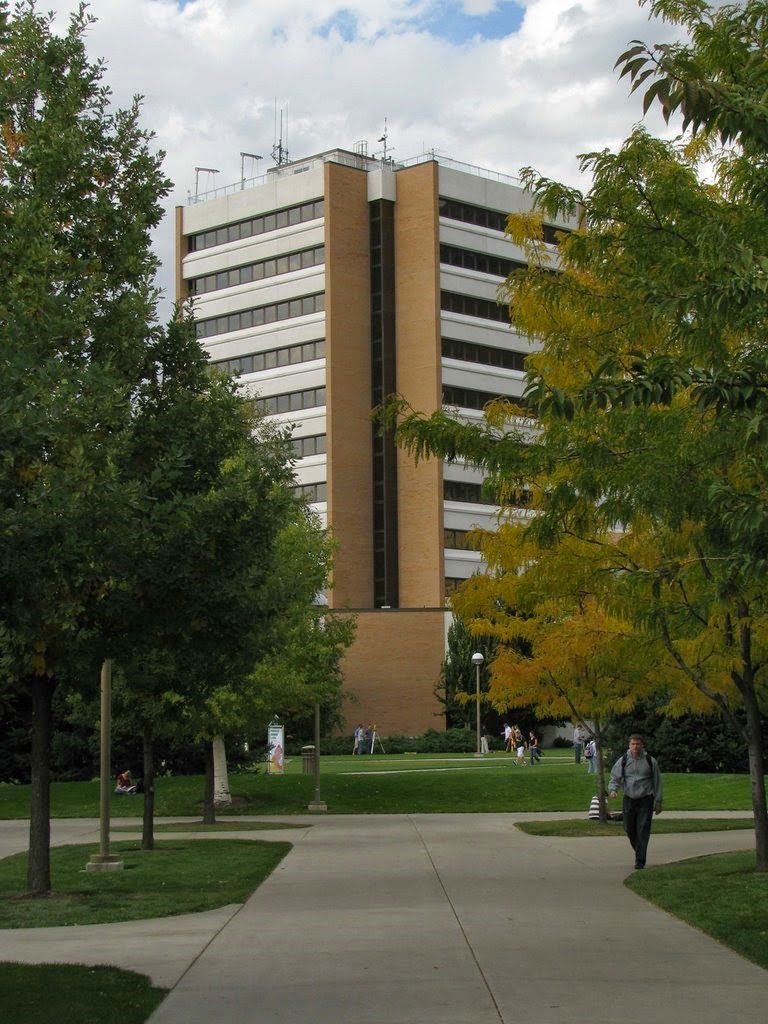
Spencer W. Kimball Tower (SKWT)
Dana Jensen, photographer. credit

Change

When I attended BYU from 1984-1987, we reverently referred to this building as "The Kimball Tower."  The edifice was only 3 years old when I arrived as a 17 year-old Freshman.  It was named after our beloved prophet Spencer W. Kimball.  It's abbreviation on campus maps was SWKT (Spencer W. Kimball Tower). The tallest building on campus and in the entire city of Provo, it was a sort of beacon, a reminder to look to the living prophet. In my sophomore year President Kimball died, and I felt devastated as did many BYU students.  He was such a caring man, a hero to me. 

Thirty years later, the students refer to the building as the "SWI-kett" irreverently phoneticizing the building's acronym, not acknowledging nor likely even aware of the legacy of the building's namesake. How did this happen?  One of Chelsea's professors who was perhaps 15 years my junior, opined that building is an architectural disappointment with poor lighting and a claustrophobic interior.  Surely not! 
Since my BYU departure the campus has welcomed new buildings named after the prophets that succeeded Spencer Kimball - The Ezra Taft Benson Building (1995) and The Gordon B Hinckley Alumni and Visitor's Center (2007).  I hope no one characterizes them as design disasters!


Graduation Day!

It was a wonderful ceremony, with pomp, circumstance AND elation!  Uplifting speakers and a musical number, of course.  But then on to the main event.  We watched approximately 600 students from the College of Family, Home and Social Sciences march up and be recognized for the wonderful achievement of completing a college education.  I loved watching the walk of the students - erect, swift, balanced.


I am trying to imagine it now from each student's perspective.  Lined up outside the Marriott Center according to major - then herded inside.  Sitting in assigned seats amongst a sea of energized students in blue.  Waiting one's turn, lining up, flipping the tassel from one side to the other and shaking hands with the Dean and other important people.  Receiving a diploma cover, but not the actual diploma (that comes in the mail!)  Smiles, pride, confidence, expectations, nervousness, HOPE (Chelsea's middle name).  


Sunday, May 11, 2014

Breakfast for Mom: Fulfilling the Unwritten Mother-Child Contract

It is 6:15 am on Sunday, May 11.  Mother's Day 2014 is upon us.  The house is quiet.  Only Shadow, our pet schnauzer-poodle is awake with me.  I am thinking about Mother's Days past, when my children were in grammar school.  The times I would awaken  earlier than the children but was obligated to stay in bed and pretend I was asleep.  There would be happy noise, excitement streaming from the kitchen as my children and husband worked to prepare breakfast for me.  For meeee! 

Sausage airily sizzling with occasional interrupting Pops.  Wooden spoon tap-bapping against the side of a glass bowl as a small hand stirs the pancake batter. Brass spatula scraping scrambled eggs from our old black cast-iron skillet:  clank-pfft, clank-pfft.  Bright, G-pitched  pinging of silverware dropping against a ceramic plate. Shuuup - bread placed in the toaster plunges downward to the awaiting toasting coils.  Blam-blam footsteps that seem to shake and vibrate the entire neighborhood like a timpani.  Beautiful, chaotic cadence, a symphony of  love, a symphony of anticipation, but also a symphony of hope and anxiety.  The children hope Mom will approve of their efforts and accept their offering.  They hope Mom will like it.

I feel the pressure.  It is my job to appear grateful enough, impressed enough to bolster the budding self-esteems.  This has got to be the most wonderful breakfast in the world, and I, not them, have got to make it so.  No matter what sort of breakfast I have idealized, I've got to help them feel like the actual breakfast is exactly what I wanted.  They have to know that they did a good job taking care of me this morning.  This helps them grow into serving, happy, well-adjust persons.  It's my job as a Mom to be impressed.  Thankfully, I don't have to act too much.  This will be the most wonderful breakfast in the world.  Because they made it.  For me.  My opinion matters more than anyone else's in the world.  And so the breakfast cannot be anything less than more wonderful than any other.

The clanking and clattering goes on for a while.  When it becomes quiet, it is my cue to relax down in the covers and close my eyes.  Soon I hear child-soft voices outside my door.  The door bursts open and then it's HAPPY MOTHER'S DAY!  Dad carries the tray of hot food - a token of love as well as expectations - and places it on the bed next to me.  I open my eyes.  "Oh, wow!" I say.  OH WOW.  The children have made cards for me, or small gifts assembled at school.  They are decorated with some sort of flower.  The cards say you're a good cook, thank you for taking me places, I like playing games with you, I appreciate you, you're there for me, I love you Mom.  You're the hero today.  Tears fill my eyes as I read those cards.

"Tell me about the breakfast you have made!"  I am saying.  Who was it that cooked the sausage so perfectly? And who picked the flower? And who thought of placing the nice dab of jam on the plate?  And who guessed that I wanted strawberries today?  All four children have contributed something.  I praise their talent, their creativity, their thoughtfulness.  Just as they hoped their offering would be accepted, I hope that I have responded well enough, sincerely enough.
.