Sunday, June 22, 2014

The Power of a Woman

by Rachael Bakaitis
 
Rachael as a missionary in the Trujillo Peru Mission, 2009
with friend Luz Nancy
Church of Jesus Christ of Latter-day Saints
 

We first met Maria because we were looking for someone to do our laundry. I was a brand new 21 year-old greenie missionary for the Church of Jesus Christ of Latter-day Saints and my trainer and I were opening a new area. In my Peruvian mission we didn’t do our own laundry because of the time it took to do it by hand in a country where washing machines were not main-stream and you could hire someone else to do it for very little. We asked the bishop who in the area lived close to where we rented and who would benefit from a little extra income. He suggested Sister Maria.

Maria lived just across the courtyard from us. When we first went over to visit she let us in whole-heartedly. “Oh! What a blessing it is to have missionaries again in this house!” We started to ask some friendly questions to get to know Sister Maria a little better. She was born and raised in the church and was still very active. She got married at age 18 to a returned missionary. She showed us a wedding picture and a picture of her husband as an AP with his mission president. She had four sons, all active in the church. She was struggling financially to keep up with the demands of a large family after her husband’s recent business venture had failed. She seemed to live the sugar-coated LDS life, with a small hardship mixed in. We decided that the money we would pay her to wash our laundry each week could help her, and so we gave her the job. As a missionary of only one week’s experience in the field, little did I know that that was not the only thing she needed. Little did I know that that was not the only way we would help her.

It wasn’t long, after interacting with her twice a week for laundry pick-up and delivery, that she gained the trust to confide more in us. We soon learned that she was experiencing much more than just financial hardship. Her husband had been in a long-term affair. She was deciding if she should stay with him or leave him. On top of that, he was physically abusive to her and she had bruises to prove it. “Sisters, I know that you were set apart as representatives of Jesus Christ. I am grateful to have you in my house so often and am grateful I have someone to talk to.” She explained that she tried to talk to her bishop but felt that he favored her husband. She needed a woman to talk to. We listened and gave her the best council we could. I started to learn that the Holy Ghost really was there to help me teach and counsel in my role as missionary. My companion and I, even with my limited language abilities, felt inspired in the counsel we were able to give in every conversation we had with Maria.

Maria's desire for the counsel of a woman leader was not rare. I soon learned that, at least where I served my mission, it was common for sisters to pull us aside privately after church to ask, “Missionaries, pleeeeeaaaaase, can you stop by my house this afternoon?” We tried our best to come, even with our busy schedules. We heard about abusive husbands and boyfriends, disobedient children, problems with communication with the bishop, young women deciding if they should serve missions, hurt feelings because of gossip, financial difficulties, children in prison, women deciding if they should say yes to a marriage proposal, alcoholism, absent fathers, feelings of impotence towards church service, pregnancy out of wedlock, suicide attempts. So many things! “What a blessing to have SISTERS in this area!” was such a common thing to hear. One terminally ill sister requested that we come just to sing hymns to her. She could not talk or communicate, but she too greatly felt the need of some kind of interaction with a woman during a difficult time. One day she requested an urgent visit from us. That was our last visit. She passed away as we finished the last line of the hymn “Jesus, Once of Humble Birth.”

I am thankful that I not only taught the gospel to those who did not have it, but I was also able to be available to many women in the church who felt like they had no one to turn to. I am also thankful for the power and guidance my Heavenly Father gave me when counseling these sisters.

Rachael and  cousin Heather, 2012
Draper, Utah
 
Besides sister missionaries, the LDS church organization has another program in place that can help God manifest His power through His daughters on this earth. I believe that Visiting Teachers can play an effective role. The problem is that often they do not visit as assigned or do not always have the trust of the sisters they visit. Gossip can also be very damaging for sisters. Most of the sisters who requested our visits said that they did not have or know their visiting teachers or did not feel comfortable sharing things with those individuals assigned to them for whatever reason. This year’s general women’s session focused on the need for us, as women, to be united. I encourage all sisters to find ways to fulfill this counsel through visiting teaching.
Women's Temple Trip, 2009
Nauvoo, IL
On my mission, members would joke that we had the “mujerdocio”, a word combining the Spanish word for woman ,“mujer,” with the word for priesthood: “sacerdocio”. It was said lightheartedly but with some truth. Maybe there isn’t a word for it, but I think most members of the church can agree that there is something special that sisters hold. It’s more than what is commonly called “being a wife and mother”. No, it’s a power ALL faithful women hold. (I am neither a wife nor mother. While I feel that wives and mothers pull from this power to fulfill these amazing roles, by saying that those are a woman’s special callings, comparable to priesthood for men, we are ignoring a large segment of the LDS female membership). I found that power within me as a missionary, but, even though I have been released from that calling, I still feel that same confidence and strength within me. I also now can recognize that I had it even before my mission. Sisters that are reading this, find this power within you. It is there. Is it priesthood? Is it some sort of special ‘nurturing’ power? Is it the ‘Mujerdocio’? Or does it matter what we call it? Sadly, I have seen many members of the church who do not appreciate its potential.  I have had brethren treat me as if I were not an equal and exclude me from opportunities to lead. I have known sisters who have taken a back-seat in their own spiritual development.


Mother Peggy, daughters-in-law Megan and Rena,
daughter Marlene 2004, Allen Park, Michigan
 It can be frustrating realizing that there is not a lot of canonized scripture directly addressing the special role women play within the gospel of Jesus Christ. I know we talk a lot about it in Relief Society (the LDS church’s organization for women), but as for scripture, I always am hungry for more than what’s available. Because of that I, along with many women who may be reading this, can often feel lost within the gospel. “They say I’m special, but HOW am I special? I certainly am not treated that way!” I have found myself thinking many times. All I can say for sure at this time is that I do have a special kind of power. Those that treat me as a lesser person because of my gender are wrong. God wants me to develop the power he has instilled in me to serve his children here on earth. This is my testimony of the power of a woman.
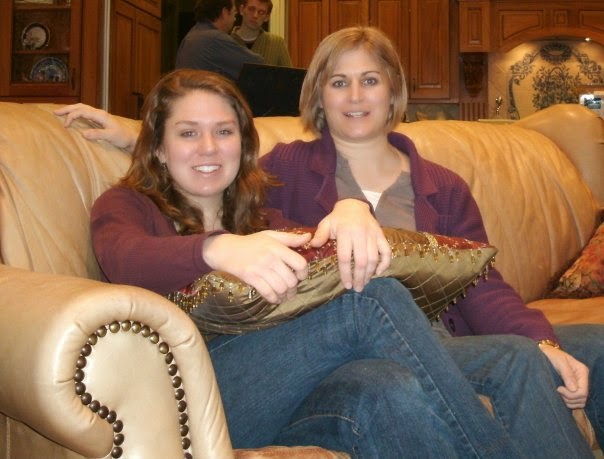
Megan and daughter Rachael, 2007
Parklands Nature Preserve, IL


Chelsea and Mother Megan 2010
Bountiful, Utah


Sunday, June 15, 2014

Tribute to My Dad

Based on the Life Sketch I delivered at my dad's memorial service in Petaluma, California on April 17, 2011

Nolan Ralph Cordon was born in Driggs, Idaho February 3, 1930 to Audrey Nelson and Edgar Cordon.  He was the fourth of six children.  He died April 6, 2011. 

Let me back up a minute.  Dad's life didn't really begin in 1930, nor did it end in 2011.  Before he was born into mortality, he lived with his Father in Heaven, as did all of us.  It was God's plan for Nolan to come to this earth.  When he departed in 2011, he was taken home to that God who gave him life.  My father is now in a state of peace and happiness, and he rests from all his troubles and from all his care and sorrow. (See Alma 40:11-12 in the Book of Mormon)

Let's return to my father's mortal life...  Born on a potato farm at the start of the Great Depression, he grew up in humble circumstances.  He spent his childhood at the foot of the Great Teton mountains, which he described as being the most beautiful place on earth.

He had a wonderful childhood - riding horses, working on the family farm, and finding ways to get into mischief.  For a few years the family lived above the town drugstore.  One day Nolan and his brother climbed up to the roof of the building, and they brought balloons filled with water.  Can you guess what they were doing up there?  You see, they weren't actually trying to strike anyone with the balloons; they were aiming for the pavement.  They wanted to see how close the balloons could land without hitting anyone.  A police officer brought the boys home.

Dad had a wonderful sense of humor which developed and thrived in Driggs, Idaho with the large Cordon family.

My father learned how to be a hard worker during his childhood.  When he was 13 he dropped out of school one January day.  He informed his father he wasn't going back to school.  Rather than argue with Nolan, my grandfather, Edgar Cordon, told him that since he was going to be home, he could hitch up a team of horses the next morning and open up a hay stack.  It was the middle of winter and bitter cold.  The haystacks were covered with ice so it was necessary to break the ice off the surface first.  The hay underneath was very wet and heavy.  The job took Nolan all day.  The next morning he informed his father that he decided he wanted to go back to school.

Dad attended school in Arizona for a couple of winters.  His family lived in a 10' x 6' homemade trailer in his Uncle Nuel's backyard during the cold season, as the Arizona air seemed to be friendlier to Grandpa's lungs than the cold Idaho air.  He was instructed by his mother never to go into Nuel's home; she said that they had troubled Nuel's family enough by being in their backyard.  Consequently, Dad spent a lot of time outdoors during those Arizona winters.

When Dad was 14 and 15 he spent two summers high up in the Tetons herding sheep.  I believe those were lonely times, but also a great growth experience as Dad learned about personal responsibility.

The next time my father dropped out of school was to join the US Navy in 1947. He was 17 years old.  His high school sweetheart Roberta (and future wife) cried her eyes out because she had no date for the prom that year.  She was mad for a very long time.

Joining the Navy was one of the most important decisions of Dad's life. While Dad was serving in San Diego, California, the Korean war broke out.  His active duty time was extended and he was deployed to the Sea of Japan.  He served as a hospital corpsman on a Navy Destroyer.

Dad didn't talk about his war time much, but there was one story he liked to tell.  During basic training Dad earned the Sharp Shooter distinction, owing to the fact that he had practice shooting squirrels up in the Idaho wilderness.  However, he was prohibited him from using firearms in military conflicts because he was a Medic.  But one day a barrel was found floating in the water close to the ship.  The crew did not know if it was booby-trapped to be a bomb, or just a random barrel.  Dad's commander handed him a rifle and ordered him to shoot the barrel, hoping to explode any bomb before it collided with the ship. So Dad shot, violating the Geneva convention.  He made his mark, but the barrel never did explode.

Dad's experiences in the Navy gave him confidence to pursue a career in medicine.  After honorable discharge, he attended college at Idaho State University in Pocatello, and married his childhood sweetheart, Roberta Larsen in 1953. They were sealed for Eternity by sacred Priesthood Power in the LDS Idaho Falls Temple.

During the summers Dad helped to build the Teton Dam.

Dad attended medical school at the University of Oregon in Portland.  During this period Shelly was born in 1959 - her parents had hoped, prayed and waited seven years for her.  Two sons, Scot and Derek joined the family while Dad was completing his residency in San Bernardino in Southern California in 1963-1964.  After residency the family settled in Petaluma, California, and Megan (me) was adopted in 1966.

Nolan, my dad, was one of the last general practitioner Country Doctors.  He treated sore throats and gout, delivered babies, removed tonsils and appendix, repaired hernias and even made house calls.

While practicing general medicine for about 15 years, Dad experienced frustration that he couldn't help everybody.  He was a sensitive man who felt for people's suffering.  His own father had been ill for all of Nolan's life, having contracted tuberculosis in World War I.  At the end of his life, conventional medicine could do very little for Edgar.  In the late 1970's Dad became interested in alternative medicine as a way to relieve people's suffering.  He attended acupuncture school in San Francisco at the American College of Traditional Chinese Medicine, and also became a pupil of Dr. Paul Nogier, an ear acupuncturist in France.  Dad quit his general medicine practice and became one of the first medical acupuncturists in the United States.  He was the very first auricular (ear) acupuncturist in the US, and introduced the discipline to many North American healers as he traveled and lectured all over the United States and Canada.  He was a pioneer in the field.

My father taught me to think outside of the box.  For example, he grew Vitamin C crystals in his office, which he attached to the end of bent glass rods (we called them "wands.")  Whenever I had any sort of physical complaint, he would pull a Crystal wand out of his front shirt pocket and grab my wrist to feel my pulse.  He'd wave the wand around to diagnose, check for changes in my pulse and treat the problem by directing energy from the crystals.  Sometimes he would also use colored slides to "tune up" my Aura (personal energy field).

My father taught me to challenge conventional thinking.  He challenged theories of allopathic medicine.  He challenged official versions of history.  He liked to discuss politics and was quite the conservative.  He always did it in a nice way however, and had more tact than I'll ever possess.  But Dad never challenged things he considered to be matters of faith or God.  I never heard him express one word of doubt regarding any Gospel teachings.

During Dad's time as a doctor, and later as a Bishop and Stake President for the LDS church, he took a lot of phone calls.  This was before the era of text messages or even pagers.  Patients would call Dad at home.  Church members would call him at home.  Sometimes with the church members, the calls were both about church business and some physical complaint.  Dad listened and helped as best he could.

During the last few years of his life, Dad turned his healing intentions to me, as I was swimming through a difficult period.  He would always ask "How are you doing?" "How are those wonderful kids of yours?"  He was always encouraging "You're a good mother... I don't know how you do it all." "You're wonderful." "I'm proud of you."

People looked to Dad as a spiritual and medical advisor.  He had dark periods in his own life when he felt very blue.  Most people were unaware of the extent Dad suffered from depression.  But no matter what was happening internally, my father made time for people.  He listened, told jokes and was very patient.  His kind and gentle nature endeared himself to many over the years.  His blue eyes would often twinkle, and he had a sincere smile.  He found amusement and laughter in simple things.  Children and teenagers related well to him.

There was a period of about a year that a disabled young man phoned my father daily just to talk.  He would phone at dinnertime, right after Dad got home from work.  He called Dad daily, and Dad talked to him daily, always patient and loving.

After retirement, my parents served a mission for the Church of Jesus Christ of Latter-day Saints in 2002-2003.  Nolan was the medical advisor for 13 mission on the Eastern seaboard of the US.  He took calls from missionaries all day long.  I was able to witness this first hand, as I visited him in Connecticut a couple of times.  The last visit was to help my parents pack when they departed the mission.  Missionaries were still calling him up until the day he left, and Dad was patient and kind to them, naturally.

My mother, Roberta passed away in January of 2004 after an extended illness (she was in the hospital for four months directly after returning from Connecticut).  Dad was devastated.  He spent one long, lonely year -- the longest in his life.  Then, he hooked up with Peggy King Roberts, and she saved his life!  I am only sorry that Peggy wasn't involved in our lives earlier.  Nolan and Peggy had five years together and we couldn't ask for a more loving stepmother and grandmother.

Dad's heroes were his father Edgar Cordon and his Uncle Nuel.  Dad would say, "Uncle Nuel was the kindest man I ever knew... Except for my father; he was the kindest man I ever knew."  Uncle Nuel was a barber, and Edgar often couldn't work because of his illness.  These two men, Edgar and Nuel, had little in terms of the material possessions, status or education; yet my father looked up to them because he valued one attribute above all others - KINDNESS.

Once Dad died, I realized that he, Nolan Ralph Cordon, was the kindest person I ever knew.  Now that he is gone, it is up to all of us to become the kindest person that someone knows.
American Legion Honor Guard.  Dad was buried in Driggs, Idaho along side of
my mother, Roberta Cordon on April 13th. 

Saturday, June 7, 2014

Chelsea's College Graduation


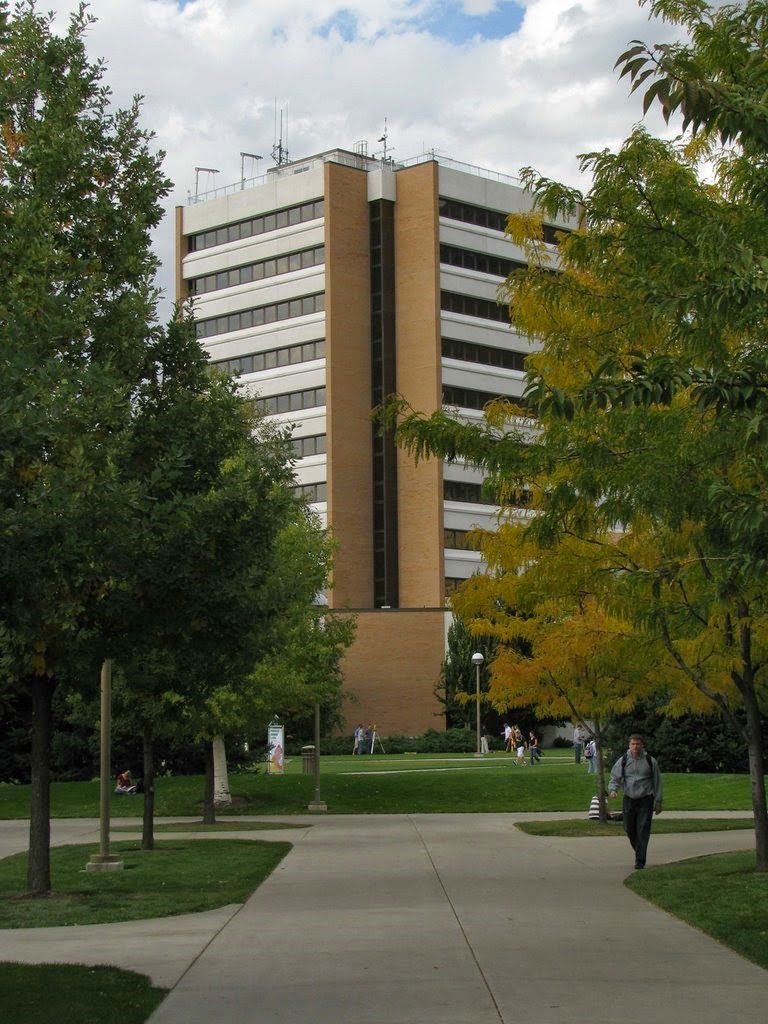
Spencer W. Kimball Tower (SKWT)
Dana Jensen, photographer. credit

Change

When I attended BYU from 1984-1987, we reverently referred to this building as "The Kimball Tower."  The edifice was only 3 years old when I arrived as a 17 year-old Freshman.  It was named after our beloved prophet Spencer W. Kimball.  It's abbreviation on campus maps was SWKT (Spencer W. Kimball Tower). The tallest building on campus and in the entire city of Provo, it was a sort of beacon, a reminder to look to the living prophet. In my sophomore year President Kimball died, and I felt devastated as did many BYU students.  He was such a caring man, a hero to me. 

Thirty years later, the students refer to the building as the "SWI-kett" irreverently phoneticizing the building's acronym, not acknowledging nor likely even aware of the legacy of the building's namesake. How did this happen?  One of Chelsea's professors who was perhaps 15 years my junior, opined that building is an architectural disappointment with poor lighting and a claustrophobic interior.  Surely not! 
Since my BYU departure the campus has welcomed new buildings named after the prophets that succeeded Spencer Kimball - The Ezra Taft Benson Building (1995) and The Gordon B Hinckley Alumni and Visitor's Center (2007).  I hope no one characterizes them as design disasters!


Graduation Day!

It was a wonderful ceremony, with pomp, circumstance AND elation!  Uplifting speakers and a musical number, of course.  But then on to the main event.  We watched approximately 600 students from the College of Family, Home and Social Sciences march up and be recognized for the wonderful achievement of completing a college education.  I loved watching the walk of the students - erect, swift, balanced.


I am trying to imagine it now from each student's perspective.  Lined up outside the Marriott Center according to major - then herded inside.  Sitting in assigned seats amongst a sea of energized students in blue.  Waiting one's turn, lining up, flipping the tassel from one side to the other and shaking hands with the Dean and other important people.  Receiving a diploma cover, but not the actual diploma (that comes in the mail!)  Smiles, pride, confidence, expectations, nervousness, HOPE (Chelsea's middle name).  


Sunday, May 11, 2014

Breakfast for Mom: Fulfilling the Unwritten Mother-Child Contract

It is 6:15 am on Sunday, May 11.  Mother's Day 2014 is upon us.  The house is quiet.  Only Shadow, our pet schnauzer-poodle is awake with me.  I am thinking about Mother's Days past, when my children were in grammar school.  The times I would awaken  earlier than the children but was obligated to stay in bed and pretend I was asleep.  There would be happy noise, excitement streaming from the kitchen as my children and husband worked to prepare breakfast for me.  For meeee! 

Sausage airily sizzling with occasional interrupting Pops.  Wooden spoon tap-bapping against the side of a glass bowl as a small hand stirs the pancake batter. Brass spatula scraping scrambled eggs from our old black cast-iron skillet:  clank-pfft, clank-pfft.  Bright, G-pitched  pinging of silverware dropping against a ceramic plate. Shuuup - bread placed in the toaster plunges downward to the awaiting toasting coils.  Blam-blam footsteps that seem to shake and vibrate the entire neighborhood like a timpani.  Beautiful, chaotic cadence, a symphony of  love, a symphony of anticipation, but also a symphony of hope and anxiety.  The children hope Mom will approve of their efforts and accept their offering.  They hope Mom will like it.

I feel the pressure.  It is my job to appear grateful enough, impressed enough to bolster the budding self-esteems.  This has got to be the most wonderful breakfast in the world, and I, not them, have got to make it so.  No matter what sort of breakfast I have idealized, I've got to help them feel like the actual breakfast is exactly what I wanted.  They have to know that they did a good job taking care of me this morning.  This helps them grow into serving, happy, well-adjust persons.  It's my job as a Mom to be impressed.  Thankfully, I don't have to act too much.  This will be the most wonderful breakfast in the world.  Because they made it.  For me.  My opinion matters more than anyone else's in the world.  And so the breakfast cannot be anything less than more wonderful than any other.

The clanking and clattering goes on for a while.  When it becomes quiet, it is my cue to relax down in the covers and close my eyes.  Soon I hear child-soft voices outside my door.  The door bursts open and then it's HAPPY MOTHER'S DAY!  Dad carries the tray of hot food - a token of love as well as expectations - and places it on the bed next to me.  I open my eyes.  "Oh, wow!" I say.  OH WOW.  The children have made cards for me, or small gifts assembled at school.  They are decorated with some sort of flower.  The cards say you're a good cook, thank you for taking me places, I like playing games with you, I appreciate you, you're there for me, I love you Mom.  You're the hero today.  Tears fill my eyes as I read those cards.

"Tell me about the breakfast you have made!"  I am saying.  Who was it that cooked the sausage so perfectly? And who picked the flower? And who thought of placing the nice dab of jam on the plate?  And who guessed that I wanted strawberries today?  All four children have contributed something.  I praise their talent, their creativity, their thoughtfulness.  Just as they hoped their offering would be accepted, I hope that I have responded well enough, sincerely enough.
.

Sunday, April 6, 2014

Random pictures


Sheep!  I found myself taking so many pictures of sheep.  They were everywhere we went. 
Here they are on the road next to our rented cottage.


Newborn lamb nursing.  On one of our hikes up the hill, we got to watch a teenage sheep farmer lure a mama sheep into his a truck by holding her bleating newborn lamb in front of her as he slowly led her to the road.  She followed the sounds of her baby until both were safe on the truck bed.  We asked him how old the lamb was, and he said about 20 minutes.
 It was an unusually cold spring, and the lad's father told us they risked losing lots of lambs born up in the mountains if they did not get them inside quickly after birth.

The only head shot of me from the trip. 
I just have to say that this is not a glam shot. 
 

Jim at the beach near Keel.  The sound of the waves on shore made me homesick for California.
One evening I bought fish from a local seafood market.  The woman who served me said her husband and father were both professional fisherman, and this was a same-day catch.  She recommended the Turbot and the Brill, species I had never heard of here in the States.  She said don't do anything fancy to prepare the fillets, just fry in butter.  Oh my, it was delicious!
Having grown up in the San Francisco Bay Area, I have always considered myself to be a judge of good seafood; I miss it dearly living in the Midwest.  And this was the best! 

Jim, Aaron and Ben with a random donkey
 
Stuffed suitcase!
Let it be known that I am not bringing sweaters back for everyone and their dog next time I travel internationally.  I've done it when I've been to Ecuador, Scotland, Peru and now Ireland.  DO YOU KNOW HOW MUCH ROOM SWEATERS TAKE UP IN THE SUITCASE?  WELL, DO YOU?  A lot.  Irish wool sweaters are beautiful, but way overpriced at the tourist stores.  One sweater costs about $75.  Just get one at TJ Maxx next time.  We ended up buy like 6 sweaters for family (some had given us money ahead of time, we're not so much spendthrifts).  I think we paid the store owner's rent for the month.  I'll buy you all scarves or jewelry next time.
 
 
Cigarettes sold at the London, Heathrow Airport. 
I wish tobacco products in the U.S. would come with such prominent warnings.

 
Pictogram at the London, Heathrow Airport. 
As we walked by, Jim said, "Hey, that man has airplanes coming out of his head," 
Ben simply said, "Antler Man."


Coal Mine Museum and a Flat Tire

On the second day of our stay in Ireland, Saturday, the pouring rain put a damper on our plans for some hiking.  We decided to visit an old coal mine that was a 2-hour drive away, since Ben was studying geology at college and expressed an interest.  It was my turn to drive.  I gripped the steering wheel tensely as I tried to stay in the center of my lane on the narrow, winding Irish roads.  All three of my passengers complained about my driving-- they said I hugged the shoulder too tightly.  I was doing the best I could, but not adjusting well to driving on the left side of the road.  Funny, I had done it years ago in Scotland without much difficulty, but I suspect my eyesight wasn't that keen in 2013.  I finally got eyeglasses a month ago in March 2014 and can see roads and signs a lot better now.  No wonder the Irish rental car companies charge Americans such outrageous insurance costs.

And then there were the confounded Roundabouts!  In Ireland there are very few normal left turns at intersections.  Instead there are these circular roads with spoke roads coming out.  You drive around in this circle until you see the road you want and then you take a risk and follow the spoke.  Roundabouts are actually more efficient than timed traffic lights common in the US, and certainly genius compared to Michigan Lefts.  Even so, I was quite white-knuckled driving around them, always worried that I'd take the wrong spoke or that I'd turn into the wrong lane to see traffic barreling down at me.  It's easy for an American to become flustered with roundabouts.


Well, we got into the town of Boyle, and with all the traffic and roundabouts and I hit a curb rather hard, which pissed me off because I did not want fulfill the stereotype of the "woman driver" with my male heckling passengers.  I just knew what they were really thinking.  My passengers scolded me for hugging the edge of the road too tightly of course, but I continued on driving and eventually got us to the Arigna Mining Experience. 


After lunch at the coffee shop we took the tour, guided by a retired miner --  a real subject matter expert.  The mine began operations in the 1700's and finally closed its doors in 1990.  I regret we probably came across as ignorant, arrogant Americans.  The truth was, Jim, Ben and I hardly understood a word our guide said.  Prior to coming there, we had believed we were somewhat proficient at deciphering Irish dialects, but the Roscommon Coal Miner accent was too unfamiliar.  I suspect it would be a similar experience if an Irishman learned New York City speech and then was transported to a Mississippi Bayou. 

14 year-old Aaron however, understood it all.  You see, prior to going to Ireland I had advised him to watch some Irish videos on YouTube so that he could become familiar with the accent.  He took my advice to heart and apparently had become proficient at Irish speech.  I should have done the same, and spent some time on Irish Youtube instead of watching reruns of Deep Space Nine on Netflix.  Chief O'Brien's speech did me no good at Arigna.

Despite the language barrier, we learned one thing for sure:  You drill 18 meters in one direction and then 18 meters in the other.  Our guide repeated that phrase several times, very slowly, as if that was the key to understanding the entire mining operation.  We nodded politely every time he said it.  Despite the Tower of Babel experience, we had a lot of fun on the tour (we love rocks and caves in the Bakaitis family!)


----------------------------------------------------------------
When we arrive back to the car we notice that the front drivers-side tire is low.  Thanks to me hitting the curb back there in Boyle.  We head back to the town and put air in the tire.  However, by the time we get there, the tire is flat.  Really, really flat.  We try filling it with air, but it won't hold.  Rain is pouring down and the temperature is dropping as dusk approaches. 

We find no spare tire in the trunk. Instead, there is this tire repair kit thing that blows air and latex into the tire. "Here," Jim says, handing me a compactly folded piece of paper, "would you please read the instructions and tell me how this thing works?"

After getting our tire inflated and treated with latex, we find out that the only tire vendor in town closes at 5pm on Saturday.  It is now 5:30. The only thing to do is to try to make it back to our cottage on Achill Isle.  We bow our heads as a family and offer a prayer that the tire will carry us home.  At first the prayer seems to go unheard, as the air doesn't stay long.  We call Enterprise Car Rental, who advises us to drive to Knock airport where, they say, we can exchange our rental car.  We arrive at Knock airport only to find that all of the car rental booths are closed.

It is now very dark and wet, our tire is flat again, and there are no hotels in sight.  We are in the middle of nowhere.  I am contemplating how it's going to be to spend a cold night in a car in the rural Irish Countryside, and what we are going to do the next morning.  I am not seeing the fun in this.

I am almost in tears by now.  I feel terrible.  "I am sorry," I say, "This is my fault.  I was a bad driver." (It takes a lot for me to admit I am a bad driver.  Ever!)

"Mom," says Ben, "None of us cares that we have a flat tire.  We're on vacation.  This is just another adventure.  It's just all the Tourist Experience... Don't worry. ..." 

"Yeah Mom," Aaron chimes in.  "It's OK.  We love you, Mom."  With that kind of optimism, my kids must be Irish.

We stop at a gas station, and Jim gets an inspiration to buy three cheap latex tire spray things.  He fills the tire up with more air and latex and we head off again towards our cottage.  He somehow knows the tire is sturdy enough to make it home.  We stop a few more times during our journey home to repeat the procedure.  Driving 40 mph (64 kph) or less the whole way, we arrive back to our cottage around 11pm.

Our prayer was answered, not by having the tire fixed, but by enlightening Jim's mind to know what to do.


The Deserted Village at Slievemore and the Old Keel Cemetery

For some reason I had it in my mind that this place was called the "abandoned village," but "deserted village" sounds so much more mysterious and lyrical.  In recent history, the stone cottages at Slievemore were used as summer homes so families could take their cattle up the mountain to graze.  (The proper term is ""Booleying".)  A few old-timers on the island can even remember when they were used for such.  However archeological evidence suggests that some of the structures up on the mountain have been there from at least the Medieval times. 

It was a very soothing to walk around the dismembered stone homes.  There is beauty as well as intelligence in piled up rocks.  There really is!

Window

Our family likes to pick up rocks.  Through the years we've amassed quite a collection of geodes, petrified wood, small fossils such as trilobites, Native American arrowheads and stone tools.  It seems like we bring rocks home from any family outing.  So it was quite a delight to us to find an entire village make of rocks!  The photo ops were endless! 


Ben, Aaron and Jim in decapitated stone residence.
Ben is ready to pose for a magazine cover
The boys' patience soon ran thin with my requests for pictures...

 
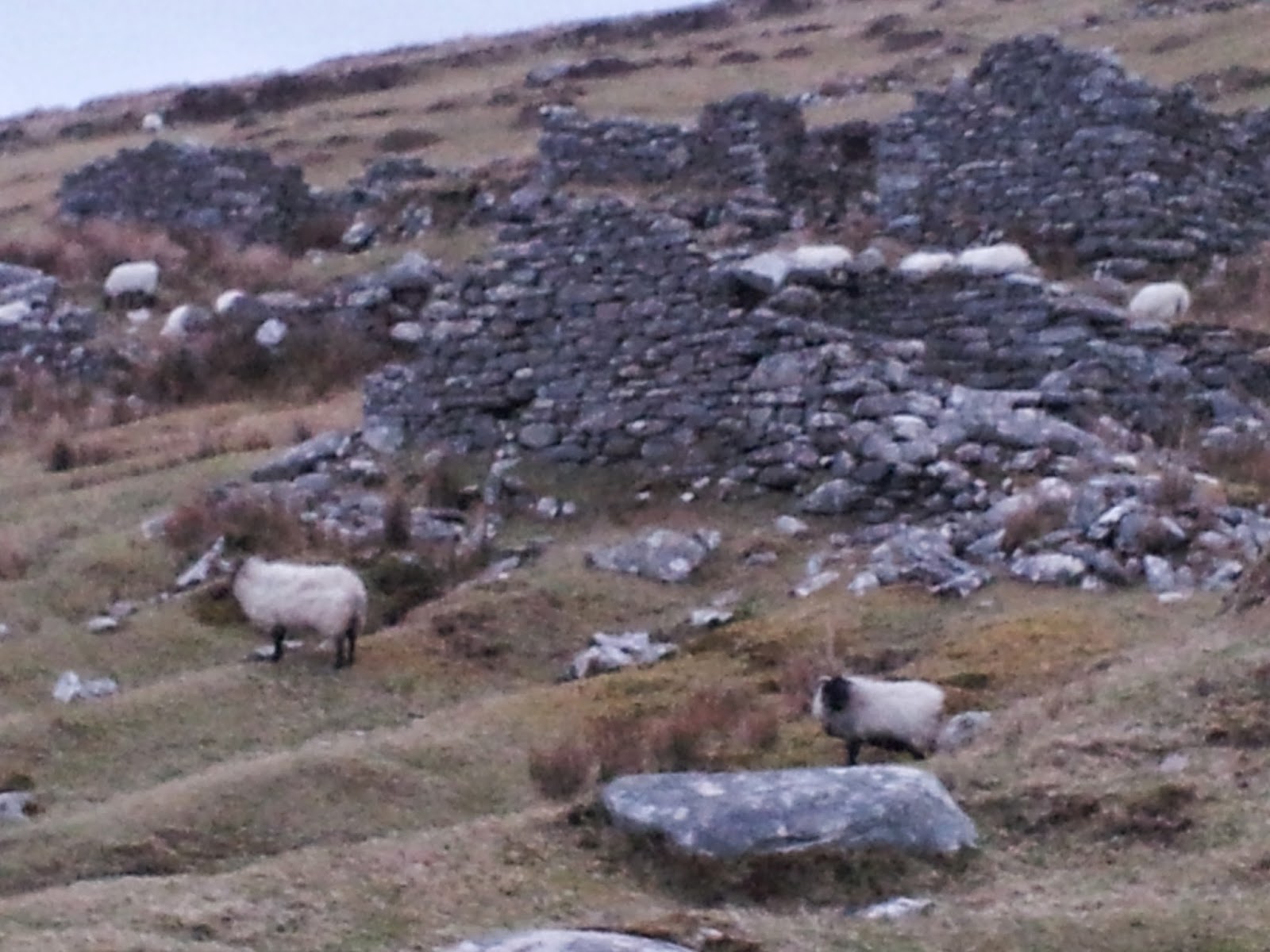
So I resorted to photographing sheep.  At least they didn't run away.


Well, some of them did run away...


 So, I finally put down my cell phone camera and just enjoyed the serenity of the place.


And my husband's habit of bringing souvenir rocks home... Well, I don't want to tattle over the Internet or get the customs folks suspicious.  Let's just say that my mother-in-law's home now displays an interesting keepsake from the Island.


-----------------------------------------------------------------
 
The Old Keel cemetery was full of familiar surnames we recognized from Jim's family tree - Corrigan, Kilbane, Mylott, Burke, and of course - CALVEY, his maternal grandmother's surname. 


There is a certain reverence one feels when walking through cemeteries.  There is a connection between the dead and living. 
 
Many of the tombstones in the Old Keel cemetery are disintegrated so badly that you can't decipher the names.   I think the tombstones of Jim's ancestors probably are among some of those.  The names and dates are all cataloged on the Internet though.  It is these old, unreadable stones that fascinated me most of all.  Not quite forgotten memorials.  As in the Deserted Village at Slievemore, stones remind us of the past.


We gained a gem of information about his great-great-great grandmother's surname.  John Richard Calvey (b.1844) was the guy that immigrated to Cleveland from Achill Isle in the 1860's.  Oral family tradition was that his mother's name was Maude McMannon.  However, Jim and I could find no evidence that any McMannons ever lived in the area: no McMannons in the cemetery, and none in the vital records.  But... we did find was the surname McManamon in abundance!  I took the liberty of changing Maude's surname to McManamon on Jim's digital family tree at www.familysearch.net.  I hope that grandma Maude is smiling there on the other side, satisfied that we finally got her name right! 
 
When doing Family History work, sometimes you just have to be there, walk the roads your ancestors walked in order for things to finally make sense.